
The training-room cooler, and what fall sports still share between practices
The training-room cooler, and what fall sports still share between practices
September 28, 2026
AI-generated. This article was written with AI from the linked reporting and studies. Use the original sources for the full papers and published data.
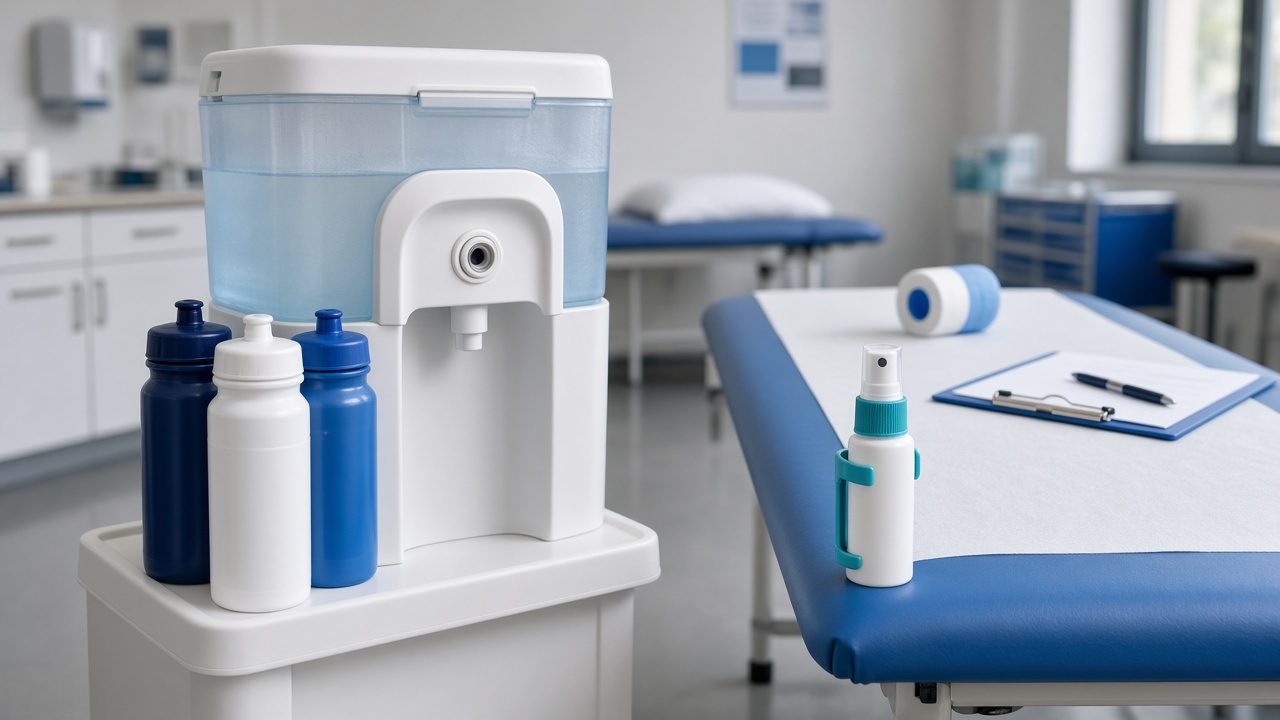
By late September, fall sports are already deep into the week. Football, volleyball, soccer, and cross-country share the same side door after practice: the athletic training room. Tape, ice, a treatment table, a sign-in clipboard — and the team cooler everyone presses between drills.
We wrote about the school-office pen in August, the flu-clinic clipboard two weeks ago, and the Chromebook cart last Monday. Education is still Cleanint's first growth priority. The question this week is narrower: when a campus runs practices six days a week, which shared objects the schedule cannot stop sharing, and what belongs next to the cooler.
Why this week, not next spring
CDC published its 2026–2027 respiratory disease season outlook on September 23, 2026. The agency expects the coming fall and winter peak for COVID-19, influenza, and RSV hospitalizations to look similar to last season — within about 20% of the 2025–2026 combined peak — with low to moderate confidence. As of mid-September, seasonal flu activity was still low nationally. RSV was very low in most areas. That is not an argument for waiting. It is the reason athletic departments are stocking tape and ice while clinics are still offering flu shots in September and October.
Vaccination, staying home when sick, and hand hygiene remain the first lines. Surface sanitation is not a substitute for any of them. The honest bound on this article is the same one CDC uses for flu elsewhere on our site: influenza spreads mainly by droplets when people cough, sneeze, or talk. Surfaces are the secondary route — less often, not never.
What four training rooms actually tested for
In the 2017–2018 academic year, University Hospitals Sports Medicine researchers studied two high school and two collegiate athletic training rooms in Northeast Ohio. They swabbed multiple surfaces across the year while a three-phase hygiene program rolled out: disinfectant products, posters and checklists, then athlete and trainer education.
Before the program took hold, influenza was detected on 25% of the surfaces they sampled, with at least 195 viral particles on each positive site. The contaminated objects were not exotic. They included front door handles, drawer handles, water bottle lids, and water cooler nozzles. MRSA and vancomycin-resistant enterococcus (VRE) showed up on 24% of surfaces at baseline. After the full protocol, overall bacterial load fell by about 95%, those multidrug-resistant organisms were not detected on follow-up swabs, and influenza was not detected on the later samples. No training-room–acquired infections were reported during the study period.
That paper is a quality-improvement study of four rooms, not a trial of a product brand, and it does not prove a cooler caused illness by itself. It does show that shared athletic training rooms are not theoretically dirty. In rooms that look like the ones on most fall-sports campuses, influenza RNA and resistant bacteria have been recovered from the exact objects athletes and staff keep touching between periods.
Skin infections are the other half of the training-room story. State athletic guidance still treats mats, benches, and shared gear as indirect routes for bacterial and fungal skin disease alongside person-to-person contact. Football and wrestling get most of that attention. The cooler nozzle is the respiratory half of the same room: many hands, a non-porous push button, and a line that never empties until the last athlete leaves.
Why a wipe schedule stalls after practice
Treatment tables get wiped when someone remembers. Cooler nozzles and bottle lids get less of that attention. Athletes refill between drills. Trainers ice ankles with one hand and check the next clipboard with the other. Substitutes inherit someone else's water stack on game day. By the third practice of the week, the "daily clean" on the custodial checklist has already fallen behind the handoffs.
CDC's K–12 infection-prevention guidance, last reviewed May 12, 2026, still puts everyday actions first: hand hygiene, staying home when sick, and cleaning what people actually touch. Alcohol-based sanitizer is the backup when soap and water are not there, at 60% alcohol or more. An athletic training room is that guidance under fluorescent lights — a small clinic that empties and refills every afternoon.
What belongs next to the cooler
Cleanhands is the staff-and-athlete half of the idea. It clips to a belt, lanyard, backpack, or trainer's kit. One-hand dispense, no cap to drop. Each cartridge is 75% isopropyl alcohol, up to 1,000 sprays, about 2 oz. The double pack is $24.95. Athletic trainers, coaches, and student aides are the people who cannot walk to a sink between the last ankle wrap and the next water line.
The training-room list is short: the cooler station, the treatment-table aisle, the weight-room door, the locker-room exit before practice, the bus before an away game. If the sanitizer is not where hands already stop, it will not get used.
CleanintUV belongs in a different sentence in the same room. Phones, pulse oximeters, badges, and therapy remotes never get washed between athletes. An enclosed UV-C cradle is for those handhelds. Put the unit where devices already rest between uses. The unit is $249.95. It is not a claim that UV light will move a team's illness rate, and it is not a wipe substitute for every cooler nozzle on campus.
Cleanpen is the clipboard product. Injury forms, concussion checklists, and parent pickup notes still need a barrel. The holder sanitizes a pen, stylus, or marker between uses and sits where people already sign. The holder with one refill is $22.99. When the cartridge runs dry, swap it ($6.95) or refill on site from an 8 oz bottle ($14.99). It is not the cooler product. It is the signature product that often lives on the same counter.
None of this claims a $25 clip-on will stop a flu season or a skin-infection cluster. The Northeast Ohio sampling is not a trial of Cleanint hardware. CDC does not list cooler nozzles on a special athletic roster, and flu is still mainly a droplet disease. The honest product claim is smaller: late September is when practice density is already high, shared training-room surfaces have shown influenza and resistant bacteria in published sampling, federal school guidance already names high-touch cleaning and hand hygiene, and sanitation that fits the after-practice line is the kind that survives Friday night.
Clip sanitizer where athletes already stop for water. Park the UV cradle where handhelds already rest. Put the pen holder on the injury clipboard. Refill all three. Keep wiping the tables and mats the schedule already names. That is what belongs next to the training-room cooler this fall.
Where to read more
CDC. 2026-2027 Respiratory Disease Season Outlook. Updated Sept. 23, 2026. https://www.cdc.gov/cfa-qualitative-assessments/php/data-research/season-outlook26-27.html
CDC. Everyday Actions for Schools to Prevent and Control the Spread of Infections. Last reviewed May 12, 2026. https://www.cdc.gov/children-and-school-preparedness/infection-prevention/actions.html
LaBelle MW, et al. Infection Risk Reduction Program on Pathogens in High School and Collegiate Athletic Training Rooms. J Athl Train. 2020;55(1):21–26. PubMed 31660785. https://pubmed.ncbi.nlm.nih.gov/31660785/