
The school-office pen, absenteeism, and what belongs on a campus
August 24, 2026
AI-generated. This article was written with AI from the linked reporting and studies. Use the original sources for the full papers and published data.
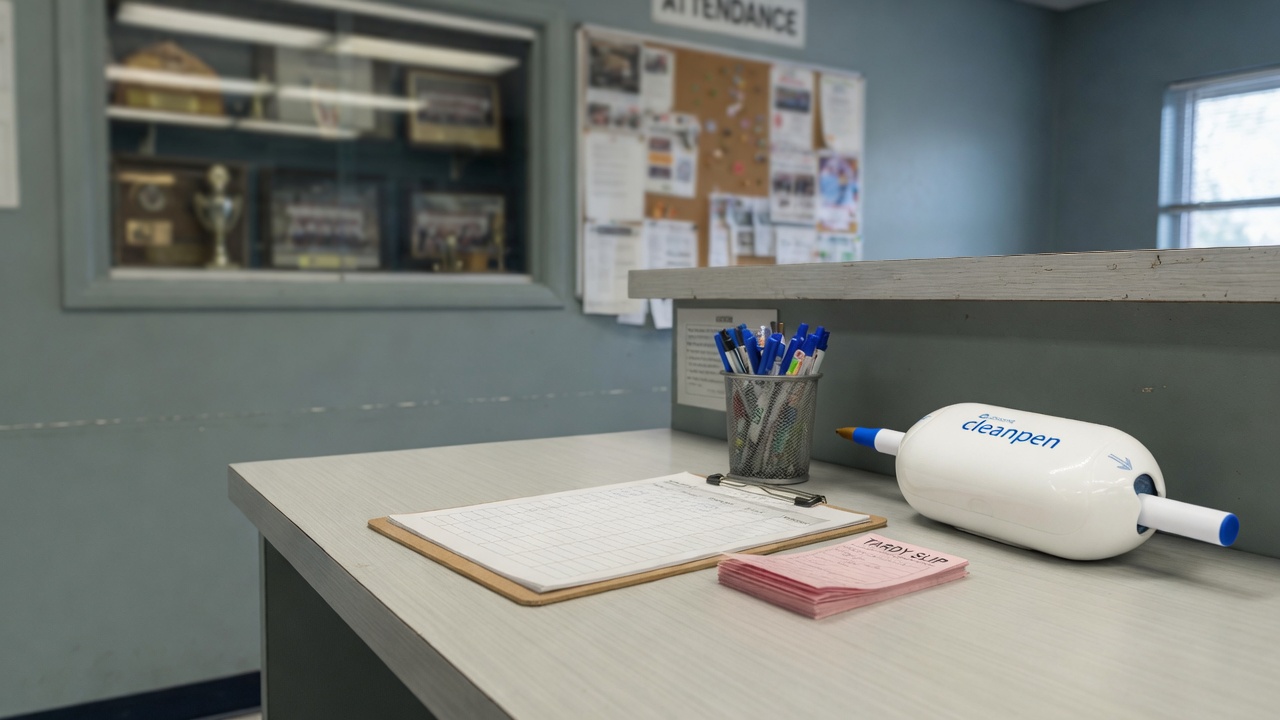
The first object most visitors share at a school is not a desk or a water fountain. It is the pen on the office counter.
A parent signs a pickup form. A student signs a tardy slip. A substitute signs in. The same barrel goes back in the cup. That is still how a school office works in 2026, and it is the part of campus hygiene that a nightly wipe of the desks does not reach.
We wrote about Cleanpen in school offices in 2018. The furniture of the argument has changed. Last winter was a high-severity flu season. Chronic absenteeism is still well above where it was before the pandemic. Education is a core Cleanint industry, and the question worth asking now is narrower: which shared objects a campus cannot stop sharing, and what actually belongs next to them.
The 22 million days, and what last winter added
Our homepage still says U.S. students lose 22 million school days a year to colds and flu. The original number is older than that sentence, and it is slightly more specific.
It comes from the 1996 National Health Interview Survey, published in 1999 by CDC’s National Center for Health Statistics. Public-health materials have cited it ever since as about 22 million school-loss days associated with the common cold in a single year — colds, not influenza, and not a 2026 remake of the same table. A 2003 analysis of the same NCHS report put non-influenza viral respiratory infection at about 21 million lost school days. We keep the figure because it is the last federal snapshot that isolated cold-related school loss this way. We do not pretend it was measured last fall.
What was measured last fall is influenza.
CDC classified the 2024–25 flu season as high severity for every age group — the first such season since 2017–18. End-of-season estimates, updated March 12, 2026, put the burden at 51 million illnesses, 23 million outpatient visits, 710,000 hospitalizations, and 45,000 deaths. Flu-associated deaths in children have been nationally notifiable since 2004. Through mid-February 2026, CDC had 290 pediatric deaths reported for that season, the highest count for a regular flu season since reporting began, and estimated the true number closer to 790 because not every related death is tested.
Hospitalization rates tell a school-shaped story even when they are not the highest in children. FluSurv-NET, covering about 9% of the U.S. population, put the 2024–25 rate for ages 5–17 at 39.3 per 100,000 — the lowest of any age group, and still 1.8 to 2.8 times the historical median across ages. Among those school-age patients who were hospitalized, 24% went to an ICU. Vaccination remains the first line of defense. Surface sanitation is not a substitute for it.
Attendance is the other number schools already live with. Across 45 states with 2025 data, chronic absenteeism — missing 10% or more of the year — sat at 22.6%, down from a 2022 peak of 28.3% and still far above the pre-pandemic 15%. Illness is one reason children miss school, not the only one. It is the reason a front office can do something about without waiting for a new policy.
How flu actually moves, and why a pen still matters
CDC’s current language is careful. Influenza spreads mainly by droplets when people cough, sneeze, or talk. Less often, a person can pick it up from a surface and then touch the mouth, nose, or eyes. People can shed virus a day before they feel sick. They are most contagious in the first three days.
That “less often” is the honest bound on this article. A ceiling lamp cannot clean a pen. A pen holder cannot clean the air. The office pen is not the main way flu moves through a building. It is one of the few objects a school cannot stop passing from stranger to stranger during the hours when virus on a hard surface can still be viable.
CDC’s school-cleaning guidance puts that window at 2 to 8 hours for influenza, and says daily sanitizing of high-touch objects is the routine, not a building-wide shutdown. The 1982 Bean study, still the paper later work cites, found influenza A and B surviving 24–48 hours on stainless steel and plastic, and less than 8–12 hours on cloth, paper, and tissues. A 2011 PLOS ONE household-surface study recovered live H1N1 from most materials at four hours and from some non-porous ones at nine, then not at 24. The authors’ practical conclusion is the one that fits a school day: overnight emptying of a classroom does most of the work; the objects people keep re-inoculating during the day do not.
Colds are a different, and in some ways harder, surface problem. In a 1982 experiment, more than half of volunteers became ill after handling coffee-cup handles and other objects contaminated with rhinovirus. That is not influenza. It is the other half of the illness that empties classrooms in September.
The classroom data we have is small and should be read that way. In 2010, University of Arizona researchers sampled six elementary classrooms (148 students) in the Seattle area. Influenza A RNA showed up on 24% of surfaces overall and on 50% of surfaces by afternoon. The most bacterially loaded objects were the ones many hands use: water-fountain toggles, pencil-sharpener handles, keyboards, faucet handles. Children in the three classrooms that were not wiped daily with a quaternary-ammonium wipe were 2.32 times more likely to report illness-related absenteeism. The authors called it preliminary. It is not a trial of a pen holder. It is evidence that the objects students share during the day are not theoretically dirty. They test dirty, and the dirt accumulates toward afternoon.
An office pen is that pattern in a smaller room. A 2008 hospital study of 75 ICU pens found bacteria on 34.6% of them; Staphylococcus aureus put onto new pens survived 48 hours on rubber grips, 24 hours on plastic, 18 hours on metal. A school office is not an ICU. The mechanics are the same: a non-porous barrel, a rubber grip, a procession of hands.
What belongs on a campus now
CDC’s K–12 infection-prevention guidance, last reviewed May 12, 2026, is built around everyday actions that keep students in the building: hand hygiene, staying home when sick, cleaning what people actually touch. Alcohol-based sanitizer is the backup when soap and water are not there, at 60% alcohol or more.
That is the layer Cleanint was built for. Not a new protocol. The objects the protocol already assumes someone will share.
Cleanpen is a holder that sanitizes a pen, stylus, or marker between uses. It sits where people already sign. The next person picks up a clean pen. That is the whole product. The holder with one refill is $22.99. When the cartridge runs dry, swap it ($6.95) or refill on site from an 8 oz bottle ($14.99). Buy the appliance once. Keep the station in service.
The school-office list is short: the front counter, the nurse’s sign-in, the attendance clipboard, the substitute desk, the visitor log. A whiteboard marker in a classroom is the same object with a different barrel. If the holder is not where the signature already happens, it will not get used.
Cleanhands is the staff half of the same idea. It clips to a belt, purse, backpack, or lanyard. One-hand dispense, no cap to drop. Each cartridge is 75% isopropyl alcohol, up to 1,000 sprays, about 2 oz. The double pack is $24.95. Teachers, nurses, bus drivers, and office staff are the people who cannot walk to a sink between the last visitor and the next one.
This is not a claim that a $23 holder will move a district’s chronic-absenteeism rate. Bright’s six classrooms are not a district. CDC does not list pens in its high-touch roster, and flu is still mainly a droplet disease. The honest product claim is smaller: the shared pen is a documented fomite, the school office is a signature station that never empties, and sanitation that does not add a step is the kind that stays in place after the first week of September.
CleanintUV belongs in a different sentence. Phones, badges, and remotes in a nurse’s office or a 1:1 classroom never get washed. An enclosed UV-C cradle is for those. It is not a substitute for a pen holder, and a pen holder is not a substitute for vaccination, ventilation, or sending a sick child home.
The tagline we have used for a decade still fits the office counter: It’s Simple — It’s Clean. Put the holder where people sign. Clip sanitizer on the people who cannot leave the desk. Refill both. That is what belongs on a campus this year.
Where to read more
CDC. How to Clean and Disinfect Schools to Help Slow the Spread of Flu.
CDC. Preventing Spread of Infections in K-12 Schools. Last reviewed May 12, 2026.
Bean B, et al. Survival of influenza viruses on environmental surfaces. J Infect Dis. 1982.
Greatorex JS, et al. Survival of Influenza A(H1N1) on Materials Found in Households. PLoS ONE. 2011.
Dey SK, et al. Writing pens as fomites in hospital. Indian J Med Microbiol. 2008.
This article was generated with AI.