
The nurse’s-office sign-in log, and what flu season sends down the hall
October 12, 2026
AI-generated. This article was written with AI from the linked reporting and guidance. Use the original sources for the full documents and published data.
Next week, October 19 through 25, is International Infection Prevention Week. APIC, the professional group for infection preventionists, is running this year's theme, "Generations of Infection Prevention," from plague doctors to Semmelweis and Nightingale to today's hospital teams. Few schools will mark it. But most public schools already have someone doing that job, usually without the title: the school nurse.
This fall we have written about the office pen, the Chromebook cart, the training-room cooler, and the polling-place check-in table. This week's object is the one that sees the sickest hands in the building. It is the sign-in log in the nurse's office.
Who is on the sign-in sheet
A student with a headache, a scraped knee, a stomachache, a fever, or a cough walks down the hall with a pass. The first thing they do is sign in: name, time, teacher, reason. Then the nurse takes a temperature, makes a call home, and the student either rests on the cot or goes back to class.
That sheet is a record of exactly who was not feeling well that day. The pen on it is touched by every one of them, one after another, often with hands that just covered a cough.
There is not always a nurse there to manage it. In the National Center for Education Statistics' 2020–21 school survey, 81.9% of U.S. public schools had at least one nurse, full- or part-time. Only 60.2% had a full-time nurse, and 24.0% had a part-time one. In public high schools, 75.2% had any nurse at all. On the days a part-time nurse is at another campus, the sign-in log usually sits in the front office or with whoever covers the cot.
Why this matters in October
CDC's 2026–27 respiratory season outlook, published September 23, expects this winter's combined COVID-19, flu, and RSV hospitalization peak to be similar to last season's, with low to moderate confidence. As of mid-September, flu activity was low. Flu hospitalizations usually peak between December and February.
The part that matters for schools is one line about last year: CDC classified the 2025–26 flu season as moderate across all ages, but as a high-severity season in children ages 0 to 17. The nurse's office is where that shows up first, one pass at a time.
October is when the habits for the rest of the year get set. The CDC's K-12 guidance is plain about what those habits are: keep students and staff home when they have a fever or worsening respiratory symptoms; let them come back after at least 24 hours with no fever (without fever-reducing medicine) and symptoms getting better; set regular times for handwashing; and clean and sanitize frequently touched surfaces and objects daily, including countertops, phones, and keyboards.
What hand hygiene can and cannot do
The honest bound is the same one we use everywhere on this site. Flu and other respiratory viruses spread mainly through the air when people cough, sneeze, and talk. Shared objects are a secondary route — less common, not zero. Staying home when sick and vaccination come first.
Hand hygiene still earns its place. CDC's summary of the research says handwashing education reduces absenteeism from gastrointestinal illness in schoolchildren by 29 to 57%, and reduces respiratory illnesses like colds in the general population by 16 to 21%. Those numbers come from handwashing programs, not from any one product. CDC also says soap and water are preferred; when they are not at hand, sanitizer with at least 60% alcohol works, and it should be stored up and out of reach of children under 6, with adults supervising its use for young children.
None of this claims a pen holder will change a district's flu numbers. The NCES survey counts nurses, not infections. The CDC outlook is a planning baseline, not a forecast. The honest claim is smaller: the nurse's sign-in pen is touched by the students most likely to be sick that day, CDC already tells schools to sanitize frequently touched objects daily, and a pen is easy to forget on that list.
What belongs in the nurse's office
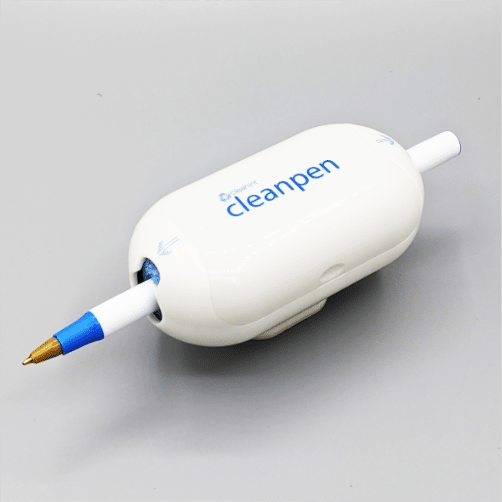
Cleanpen was built for the signature step. The holder sanitizes the pen each time it is used and sits where people already sign: the nurse's sign-in log, the front-office visitor sheet, the early-pickup clipboard. The holder with one refill is $22.99. When the cartridge runs dry, swap it ($6.95) or refill from an 8 oz bottle ($14.99). The nurse does not have to remember to wipe the pen between the fourth and fifth cough of the morning.
Cleanhands is for the nurse and the staff who cover for them. A busy morning means dozens of handoffs: passes, ice packs, thermometers, phones. It clips to a lanyard or belt, dispenses with one hand, and holds up to 1,000 sprays of 75% isopropyl alcohol per cartridge. The double pack is $24.95. It is for adult hands. Following CDC's advice, keep it with staff, not out for young children.
CleanintUV covers the handhelds that never get washed: the phone the nurse uses to call parents, and any other handheld that fits the cradle. Set it in the cradle and a UV-C cycle runs in as little as 30 seconds, with no wipe and no residue. It is $249.95. For thermometer probes and medical devices, follow the device maker's cleaning instructions.
If your district is planning for International Infection Prevention Week, the list for each campus is short: a Cleanpen on the nurse's sign-in log and the front-office sheet, sanitizer on the people who hand things to sick students, and a place to clean the phone that calls home.
Thank your school nurse next week. Then give them one less thing to wipe.
Where to read more
APIC. International Infection Prevention Week 2026, October 19–25: Generations of Infection Prevention. https://infectionpreventionandyou.org/
National Center for Education Statistics. National Teacher and Principal Survey, Percentage of schools with full-time and part-time school nurses, 2020–21. https://nces.ed.gov/surveys/ntps/estable/table/ntps/ntps2021_7062_t12n
CDC. 2026-2027 Respiratory Disease Season Outlook. Updated Sept. 23, 2026. https://www.cdc.gov/cfa-qualitative-assessments/php/data-research/season-outlook26-27.html
CDC. When Students or Staff are Sick. https://www.cdc.gov/children-and-school-preparedness/infection-prevention/when-sick.html
CDC. Everyday Actions for Schools to Prevent and Control the Spread of Transmissible Infections. https://www.cdc.gov/children-and-school-preparedness/php/interventions/everyday-actions-for-schools.html
CDC. Handwashing Facts. https://www.cdc.gov/clean-hands/data-research/facts-stats/index.html