
The polling-place stylus, and what Election Day still shares in a school gym
The polling-place stylus, and what Election Day still shares in a school gym
October 5, 2026
AI-generated. This article was written with AI from the linked reporting and guidance. Use the original sources for the full documents and published data.
Today is the last day to register to vote in Texas for the November 3 general election. Early voting in person runs Monday, October 19 through Friday, October 30. Election Day polls are open 7 a.m. to 7 p.m. Other states have their own calendars, but the shape is the same everywhere: a few weeks from now, millions of people will walk into a building they do not usually visit, stand in a line, and touch the same handful of objects as everyone in front of them.
We have spent most of this fall writing about schools — the office pen, the Chromebook cart, the training-room cooler. This week's object lives in a school too, but only for a few days a year. It is the check-in table at the polling place.
Where people actually vote
Most polling places are not election offices. In the U.S. Election Assistance Commission's survey of the 2016 general election, local officials ran 116,990 physical polling places on Election Day. Only 7.1% were election offices. The other 92.9% were borrowed buildings — schools, community centers, libraries. The EAC's 2024 survey counted 95,815 polling places, fewer than before as more voters vote early or by mail, but the buildings are the same kind. The EAC's own management guidelines list school meeting rooms and gymnasiums among the buildings to consider.
That means the gym that hosts a volleyball match on Thursday hosts a few thousand voters on Tuesday. The check-in table sits where the scorer's table was. The voting booths fill the court.
What every voter touches
Depending on the county, a voter checks in on an electronic pollbook and signs a tablet with a shared stylus or a finger, or signs a paper list with a shared pen. Then comes a ballot-marking device with a touchscreen and buttons, or a paper ballot and a marker at a booth, then a scanner. Some of those objects get wiped. Some do not get wiped often enough on a twelve-hour day with a line out the door.
The equipment makers were specific about this in 2020, and the EAC still posts their guidance in one place. Dominion told election officials to clean all units in every polling place each morning before powering on and again in the evening after shutting down, and to remind voters to use hand sanitizer. ES&S warned that disinfectant sprays such as Lysol are not permitted on its touchscreens and will damage them, that cleaners should never be sprayed directly onto a unit, and that solutions above 70% alcohol can discolor the screen. Unisyn said that where a polling location has no hand-washing station, hand sanitizer with at least 65% alcohol should be available at the registration desk.
Read together, those documents say two practical things. First, the screen and the machine follow the manufacturer's cleaning instructions, and nobody should improvise with a spray bottle. Second, the hand-held objects and the hands themselves are where a poll worker can do something between voters without touching the voting system at all.
Why this matters in October
CDC's 2026–27 respiratory season outlook, published September 23, expects this fall and winter's combined COVID-19, flu, and RSV hospitalization peak to look similar to last season's, with low to moderate confidence. Flu activity was still low nationally in mid-September. Early voting and Election Day fall before most flu seasons peak, which is good news, not a reason to skip the basics.
The honest bound is the same one we use everywhere on this site. Flu and other respiratory viruses spread mainly through the air when people cough, sneeze, and talk. Shared surfaces are a secondary route — less common, not zero. Staying home when sick, vaccination, and hand hygiene come first. Nobody should skip voting over a pen. The point is that a voter should not have to think about it.
That last part is why Cleanint has an elections line at all. Our founder, Tuan Dam, started it after hearing from people who hesitated to vote because they did not want to touch things a thousand strangers had touched. A clean pen is a small thing. Not having to wonder about it is the point.
What belongs on the check-in table
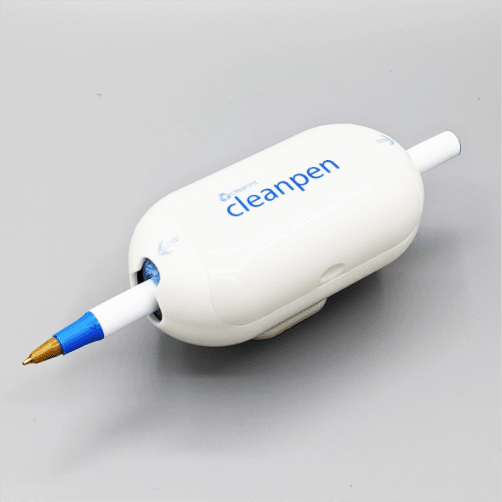
Cleanpen was built for the signature step. The holder sanitizes a pen, stylus, or marker each time it is used and sits where people already sign: the check-in table, the provisional-ballot desk, the curbside clipboard. The holder with one refill is $22.99. When the cartridge runs dry, swap it ($6.95) or refill on site from an 8 oz bottle ($14.99). It does not touch the voting machine, so it does not conflict with any vendor's screen-cleaning rules.
Cleanhands is for the poll workers. A twelve-hour shift means hundreds of handoffs: IDs, stylus, ballot sleeves, "I Voted" stickers. It clips to a lanyard or belt, dispenses with one hand, and holds up to 1,000 sprays of 75% isopropyl alcohol per cartridge. The double pack is $24.95. It is for hands. Do not use it on touchscreens; follow the equipment maker's instructions for those.
For election offices, most supply orders for November 3 are already placed. If yours were not, or if you are planning for 2027 local elections and the 2028 presidential cycle, the list is short: one pen holder per check-in station and per paper-ballot table, sanitizer at the registration desk and on every poll worker, and refills sized to turnout. Cleanint has supplied Cleanpens and refills to Texas polling places for several election cycles.
None of this claims a pen holder will change a county's flu numbers. The EAC survey is a count of buildings, not a study of infection. The vendor documents are cleaning instructions, not trials. The honest claim is smaller: most Americans vote in borrowed buildings, every voter touches the check-in pen or stylus, equipment makers already told officials to clean the machines carefully and keep sanitizer at the desk, and the objects in between are the ones a small device can actually handle.
Register if you still can. Vote early if the line is shorter. And if you run a polling place, put a clean pen where people sign.
Where to read more
Texas Secretary of State. Important Election Dates, November 3, 2026. https://www.sos.state.tx.us/elections/voter/important-election-dates.shtml
U.S. Election Assistance Commission. EAVS Deep Dive: Poll Workers and Polling Places (2016 data). https://www.eac.gov/sites/default/files/document_library/files/EAVSDeepDive_pollworkers_pollingplaces_nov17.pdf
U.S. Election Assistance Commission. Election Administration and Voting Survey 2024 Comprehensive Report. https://www.eac.gov/sites/default/files/2025-06/2024_EAVS_Report_508c.pdf
U.S. Election Assistance Commission. Election Management Guidelines, Chapter 9: Polling Place and Vote Center Management. https://www.eac.gov/sites/default/files/eac_assets/1/6/Chapter_9_Polling_Place_and_Vote_Center_Management.pdf
U.S. Election Assistance Commission. Vendor and Manufacturer Guidance on Cleaning Voting Machines and Other Election Technology. https://www.eac.gov/election-officials/vendor-and-manufacturer-guidance-cleaning-voting-machines-and-other-election
CDC. 2026-2027 Respiratory Disease Season Outlook. Updated Sept. 23, 2026. https://www.cdc.gov/cfa-qualitative-assessments/php/data-research/season-outlook26-27.html