
The Labor Day remote, and what hotels still share between guests
The Labor Day remote, and what hotels still share between guests
September 7, 2026
AI-generated. This article was written with AI from the linked reporting and studies. Use the original sources for the full papers and published data.
Labor Day weekend 2026 runs Saturday, September 5 through Monday, September 7. For a lot of properties, that means a short, hard turnover: more check-ins, more check-outs, and the same handheld objects moving from one stranger to the next.
The bed gets stripped. The bathroom gets wiped. The remote usually stays on the nightstand.
We have written about hotel remotes before, including older Cleanint posts on remotes and Healthy Hotels certification. The furniture of the argument has not changed much. What has changed is the calendar: this is the last big leisure travel weekend before fall respiratory season picks up, and hospitality is still a core Cleanint industry. The useful question is narrower than “are hotels dirty.” It is which objects guests cannot stop sharing, and what a property can put next to them without adding a step to every stay.
What the hotel-surface work actually found
In 2012, researchers from the University of Houston, with collaborators at Purdue and the University of South Carolina, sampled surfaces in hotel rooms in Texas, Indiana, and South Carolina. Katie Kirsch presented the work at the American Society for Microbiology’s general meeting. The goal was a first step toward a HACCP-style look at guest-room cleaning: find the high-risk items so housekeeping time can go where the load is.
Some of the highest bacterial counts were where you would expect — toilets and bathroom sinks. High counts also showed up on the TV remote and the bedside lamp switch. Some of the highest readings of all were on housekeeping-cart items such as sponges and mops, which raises a cross-contamination problem between rooms, not only within one.
The authors were careful about what they could not claim. The study was preliminary. The sample was small: three rooms per state, nineteen surfaces per room. They measured total aerobic bacteria and coliform contamination as indicators of cleanliness. They did not prove those bacteria were making guests sick. That bound still matters. A dirty remote is not the same thing as a documented outbreak chain. It is still a high-touch object that visual inspection alone does not clean.
Industry practice has not fully closed that gap. Housekeepers often have about thirty minutes per room and a long list of surfaces. Identifying the objects that stay dirty after a visual pass is how you decide what needs a dedicated step, not a hope that the wipe reached the buttons.
Flu season is not here yet — and that is the point
CDC’s language on flu season is seasonal, not theatrical. Influenza viruses circulate year-round in the United States, but activity typically rises in fall and winter, most often peaking between December and February. Other respiratory viruses travel in the same months: rhinovirus, RSV, COVID-19, and several others that look a lot like flu from the guest’s point of view.
Labor Day is not peak flu. It is the weekend when leisure travel, school-year routines, and the start of the colder respiratory months sit next to each other on the calendar. Guests arrive from different cities. They share elevators, pens at the desk, payment cards, room keys, and the remote. Droplets and close contact still do most of the respiratory work. Surfaces are the secondary route CDC and older fomite work keep in the conversation — less often than coughs and talk, not never.
A hotel cannot stop sharing a remote. It can stop pretending a glance at the nightstand is the same as cleaning it.
What belongs in the room — and at the desk
CDC’s community hand-hygiene guidance is still the floor: soap and water when hands are dirty; alcohol-based sanitizer at 60% or more when a sink is not close. That is guest behavior. The property’s job is the objects the guest will touch whether or not they washed.
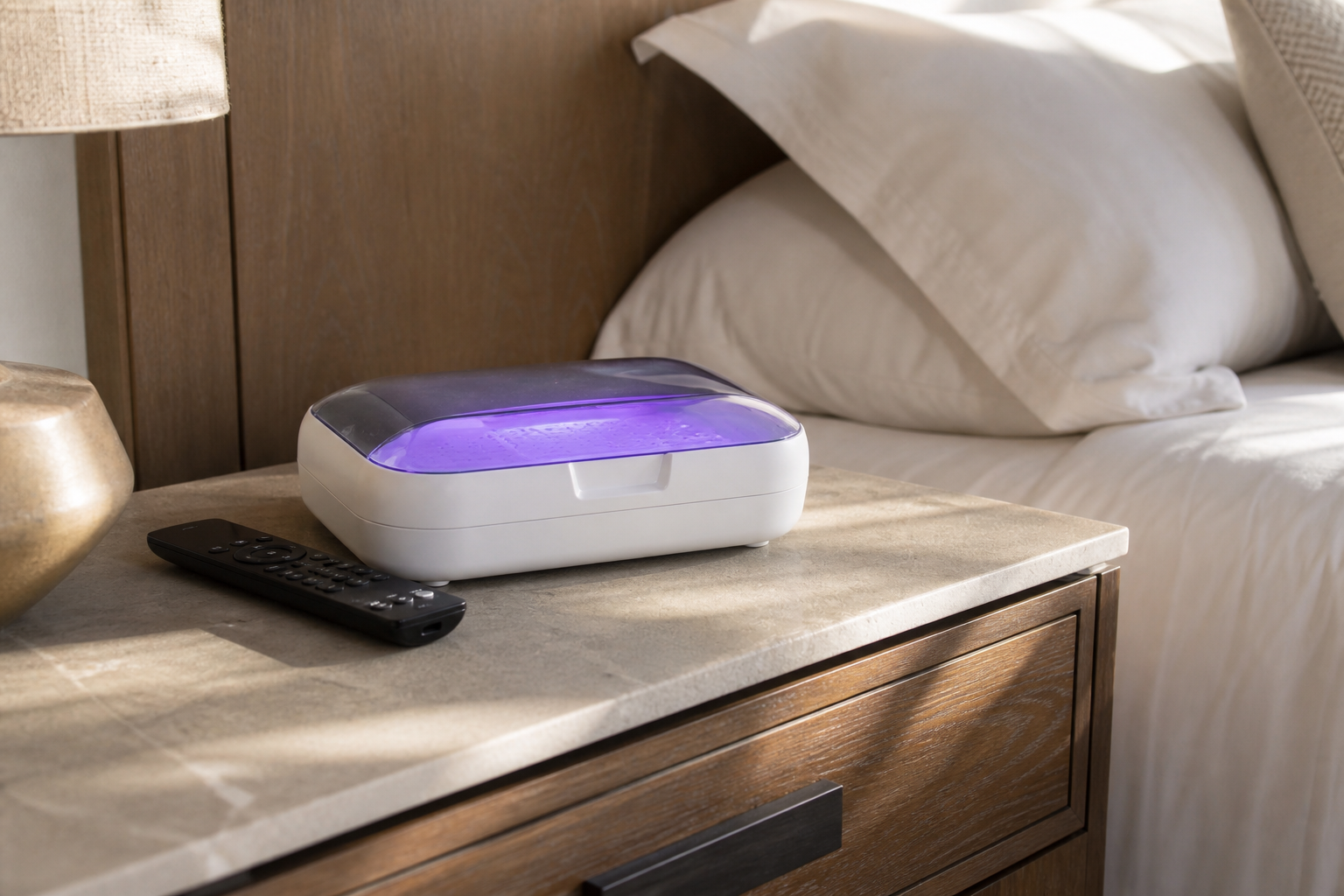
CleanintUV is the nightstand answer for remotes, phones, and other handhelds that do not survive a bleach wipe. It is a patented UV-C cradle. A sensor starts the cycle. In as little as 30 seconds the item is ready — no residue, no chemicals, safe for electronics. Independent measurements have shown CleanintUV delivering up to seven times the UV-C dose of competing units. The bulb is rated for more than a million cycles. Guest rooms, nurses’ stations, and front-desk phone banks are the usual places it lives. The unit is $249.95.
Put it where the remote already rests, or where housekeeping stages handhelds between rooms. If the cradle is in a closet, it will not get used on a thirty-minute turn.
Cleancard is the front-desk half of the same idea. Room keys, loyalty cards, IDs, and payment cards used to move hand to hand. Cleancard sits on the counter. The guest slides the card in; staff pulls it through and slides it back. Germs stay in the unit instead of becoming a handshake with the last guest’s plastic. It is $14.95, refillable, and built for desks that never empty — hotels, registration, retail, elections.
A Cleanpen at check-in is the same pattern we wrote about for school offices: the signature station that never stops. The holder with one refill is $22.99. It is not a hotel-room product. It is the desk product for the people who sign registration forms before they ever see the remote.
None of this replaces laundry, bathroom disinfection, or sending a sick employee home. CleanintUV is not a room air cleaner, and a remote cradle does not fix a dirty sponge on a cart. The honest claim is smaller: remotes and cards are documented high-touch objects in hospitality, Labor Day multiplies the handoffs, and sanitation that fits the existing flow is the kind that survives the weekend rush.
Where to read more
Kirsch K, et al. Hotel room surface contamination study presented at the American Society for Microbiology General Meeting, 2012. Covered in ScienceDaily, June 26, 2012 (“Remote controls are one of the most contaminated objects in hotel rooms”). Preliminary; small sample.
CDC. Flu Season. https://www.cdc.gov/flu/about/season.html (page reviewed Sept. 26, 2025).
CDC. About Hand Hygiene at Work. https://www.cdc.gov/clean-hands/prevention/about-hand-hygiene-at-work.html
CDC. Hand Sanitizer Guidelines and Recommendations.
This article was generated with AI.