
The party-volunteer sign-in sheet, and what Halloween brings into the classroom
October 26, 2026
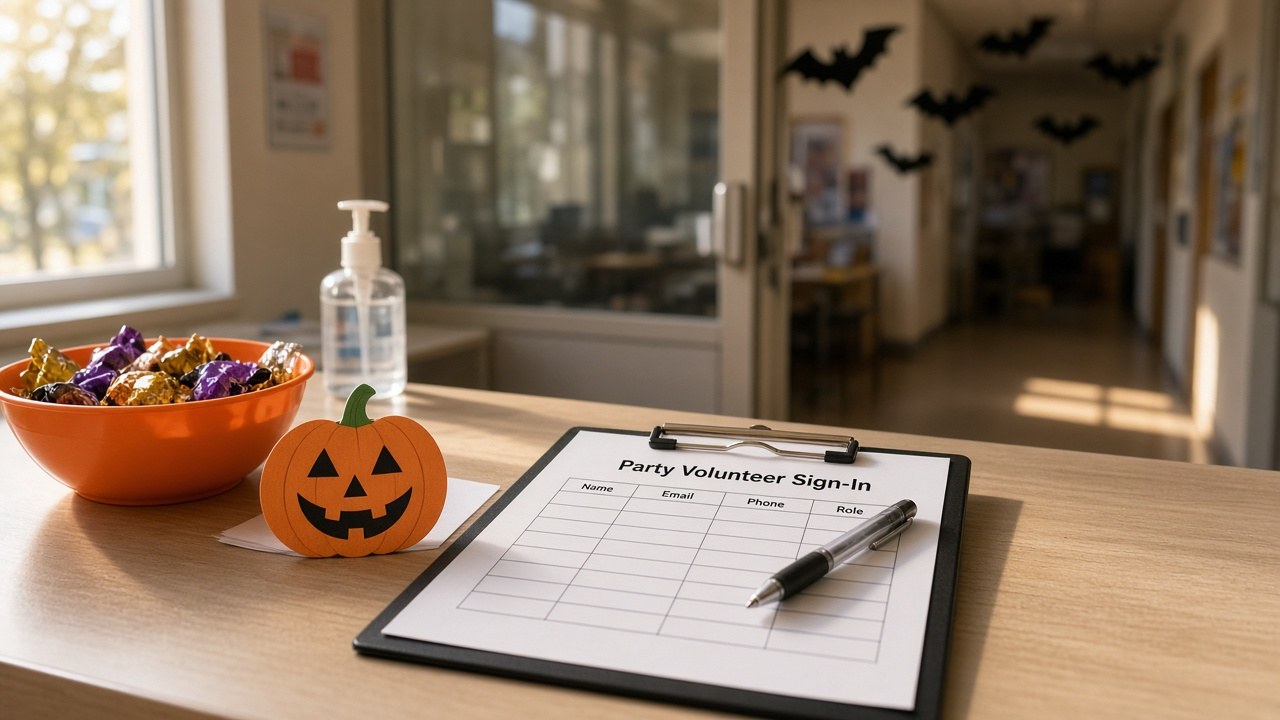
Halloween falls on a Saturday this year, so in a lot of schools the costume parade and classroom parties land on Friday, October 30. That makes Friday one of the busiest visitor days of the fall. Parents and grandparents come in to help with crafts, carry trays of cupcakes, take photos, and walk the parade route with the class.
This fall we have written about the office pen, the Chromebook cart, the training-room cooler, the polling-place check-in table, and the nurse's sign-in log. This week's object is the one every party volunteer touches before they reach the classroom: the visitor sign-in sheet at the front office, and the pen tied to it.
Who signs in on party day
On a normal morning, the front-office sheet sees a handful of late arrivals and early pickups. On party day it can fill a page before first period ends. Each volunteer signs name, time, and room, takes a badge, and heads down the hall. Then the same hands open snack packages, pass out napkins, hold scissors and glue sticks, and reach into a shared candy bowl.
None of that is a reason to skip the party. It is a reason to think about the few objects that everyone touches in a row, and the moments right before kids eat.
Why this matters in late October
Flu season is starting early this year. In CDC's FluView report for the week ending October 17, 2026, flu activity was still low nationally, but the percent of tests coming back positive, outpatient visits for flu-like illness, emergency visits, and lab-confirmed hospitalizations had all been rising since late August or early September. CDC also noted that early-season activity is higher than it usually is at this time of year. Almost all of the flu A viruses tested that week were the H1N1 subtype.
That does not mean a classroom party will cause an outbreak. It means the week of Halloween is a week when more people are carrying something, and a party brings many of them into one room with food.
What helps, in order
The first steps are not products. CDC's school guidance says to keep students and staff home when they have a fever or worsening respiratory symptoms, and to let them return after at least 24 hours without a fever (without fever-reducing medicine) and with symptoms improving. That applies to volunteers too. A grandparent with a new cough can help with next month's party instead.
Next is handwashing at the right times. CDC lists "before and after eating food" and "after blowing your nose, coughing, or sneezing" among the key times to wash hands, with soap and water for at least 20 seconds. A practical version for party day: send the class to wash before the food comes out, not after. When a sink is not close, CDC says a sanitizer with at least 60% alcohol is the backup, and it should be kept away from children under 6 and used with an adult watching for young kids.
Then the shared objects. CDC's everyday guidance for schools says to clean and sanitize frequently touched surfaces and objects daily. On party day, that list gets longer: the sign-in pen, the classroom phone or tablet used for photos, the candy bowl. A simple fix for the candy bowl is to have an adult hand out pieces instead of letting thirty hands reach in.
The honest limit is the same one we use everywhere on this site. Flu and other respiratory viruses spread mostly through the air. Shared objects are a secondary route, less common but not zero. Staying home when sick and getting a flu shot matter more than anything on a counter.
What belongs at the front office on party day
Cleanpen was built for the signature step. The holder sanitizes the pen each time it is used, so the twentieth volunteer of the morning gets the same pen the first one did. It sits where people already sign: the visitor sheet, the early-pickup clipboard, the party volunteer list. The holder with one refill is $22.99. When the cartridge runs dry, swap it ($6.95) or refill from an 8 oz bottle ($14.99).
Cleanhands is for the adults running the room. It clips to a lanyard, belt, or bag, dispenses with one hand, and holds up to 1,000 sprays of 75% isopropyl alcohol per cartridge. A room parent can clean their hands between opening packages and handing out food without leaving the room. The double pack is $24.95. It is for adult hands; keep it with staff and volunteers, not out for young children.
CleanintUV covers the handheld that gets passed around for pictures: the classroom phone or a small tablet, if it fits the cradle. A UV-C cycle runs in as little as 30 seconds, with no wipe and no residue. It is $249.95. Follow the device maker's cleaning instructions for anything that does not fit.
If your campus has parties this Friday, the list is short: a Cleanpen on the visitor sheet, a handwashing break before the food, an adult on the candy bowl, and a quick ask that anyone feeling sick sit this one out.
Have a good parade. Then let the kids take the candy home.
CDC. Weekly US Influenza Surveillance Report: Key Updates for Week 41, ending October 17, 2026. Published Oct. 23, 2026. https://www.cdc.gov/fluview/surveillance/2026-week-41.html
CDC. About Handwashing. https://www.cdc.gov/clean-hands/about/index.html
CDC. When Students or Staff are Sick. https://www.cdc.gov/children-and-school-preparedness/infection-prevention/when-sick.html
CDC. Everyday Actions for Schools to Prevent and Control the Spread of Transmissible Infections. https://www.cdc.gov/children-and-school-preparedness/php/interventions/everyday-actions-for-schools.html