
The flu-clinic clipboard, and what September vaccination sites still share
The flu-clinic clipboard, and what September vaccination sites still share
September 14, 2026
AI-generated. This article was written with AI from the linked reporting and studies. Use the original sources for the full papers and published data.
CDC’s interim guidance for the 2026–27 flu season, published September 1, 2026, is clear on timing: for most people who need one dose, vaccination should ideally be offered in September or October. School gyms, nurse offices, workplace conference rooms, and pharmacy counters are already running those clinics. The shot is the point of the day. The clipboard is not.
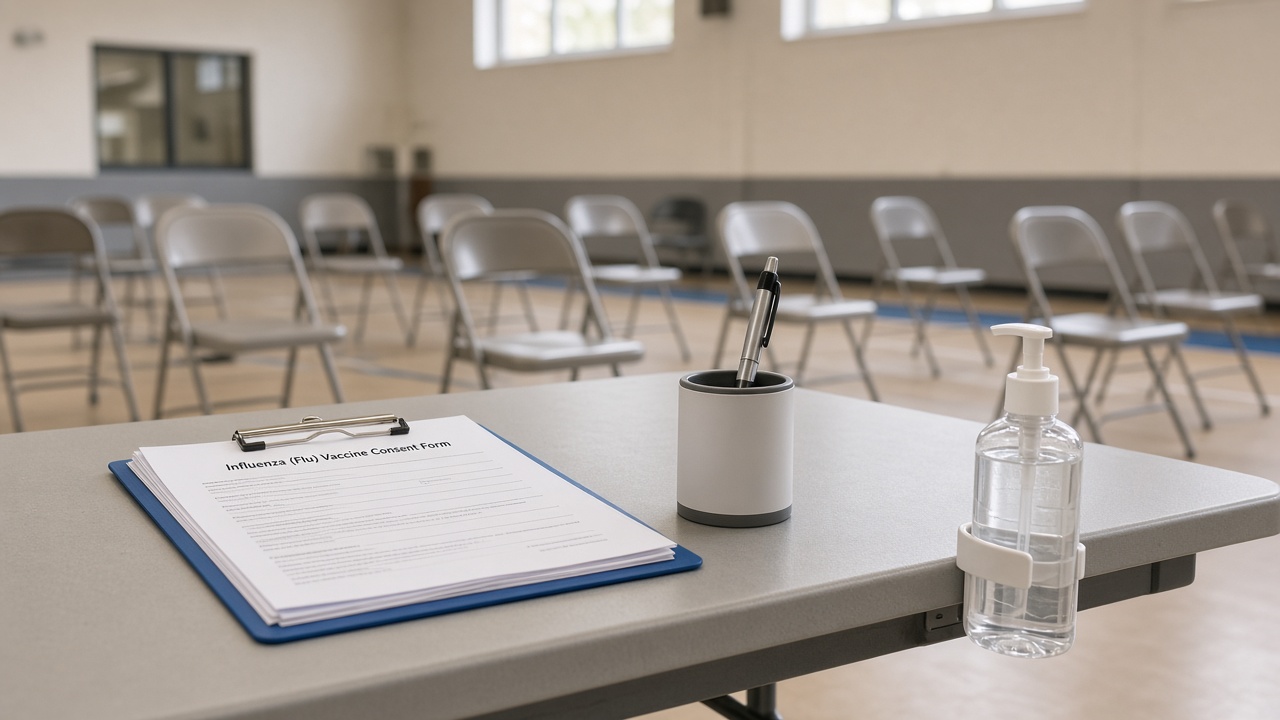
Before anyone rolls up a sleeve, someone usually signs a consent form. A parent fills out a school form. A staff nurse checks a box. The same pen goes back on the clipboard. That handoff is still how a lot of mass vaccination sites work in 2026, and it is the part of clinic hygiene that a wipe of the exam table does not reach.
Education is Cleanint’s first growth priority. Healthcare and government public-health clinics sit right behind it. We wrote about the school-office pen in August. The question this week is narrower: when a campus or county runs a flu clinic, which shared objects the line cannot stop sharing, and what belongs next to them.
Why September, not July
Flu viruses circulate year-round in the United States, but activity typically rises in fall and winter and most often peaks between December and February. CDC’s official surveillance window for the next season opens at Week 40 — early October. That is not an argument against getting vaccinated now. It is the reason the calendar on the clinic flyer says September.
The same September 1 interim clinical considerations warn against vaccinating most adults in July and August because protection can wane over a long season, especially in older adults. Children who need two doses are the main early exception: their first dose can start as soon as vaccine is available so the second dose lands by the end of October. For everyone else standing in a school cafeteria this month, the guidance lines up with the flyer on the gym door.
Vaccination is still the first line of defense. Surface sanitation is not a substitute for it. The honest bound on this article is the same one CDC uses for flu itself: influenza spreads mainly by droplets when people cough, sneeze, or talk. Surfaces are the secondary route — less often, not never.
What an outpatient clinic tracer actually showed
In 2020, researchers at the University of Arizona published a study of microbial movement in a working outpatient clinic. At the start of the day they seeded a harmless viral tracer onto two objects: a patient-room door handle and a front-desk pen. Care, cleaning, and hand hygiene continued as usual. They sampled surfaces and hands at 2, 3.5, and 6 hours.
The tracer showed up on every surface and every hand they sampled. Contamination peaked by two hours. The highest loads were on examination-room door handles and nurses’-station chair arms. Waiting-room counters and triage-seat arms were also heavily contaminated. A later ethanol-based disinfectant spray on high-touch points cut tracer levels by about 94%.
That paper did not study a school flu clinic, and it did not claim the tracer caused illness. It did show how fast a seeded pen and door handle can re-inoculate a clinic floor during a normal day. A 2008 hospital study of 75 ICU pens found bacteria on 34.6% of them; Staphylococcus aureus placed on new pens survived up to 48 hours on rubber grips. A school gym on flu-shot day is not an ICU. The mechanics rhyme: a non-porous barrel, a rubber grip, a procession of hands that never empties until the last consent form is signed.
What belongs on the check-in table
CDC’s community hand-hygiene floor is still soap and water when hands are dirty, and alcohol-based sanitizer at 60% or more when a sink is not close. Clinic staff already know that. The objects the line will touch whether or not anyone washed are the part a district or county can fix without rewriting the vaccine protocol.
Cleanpen is a holder that sanitizes a pen, stylus, or marker between uses. It sits where people already sign. The next person picks up a clean pen. That is the whole product. The holder with one refill is $22.99. When the cartridge runs dry, swap it ($6.95) or refill on site from an 8 oz bottle ($14.99). Buy the appliance once. Keep the station in service for every clinic day after this one.
The flu-clinic list is short: the consent clipboard at the gym door, the nurse’s sign-in at the elementary clinic, the county health department counter, the workplace HR table, the pharmacy intake desk. If the holder is not where the signature already happens, it will not get used.
Cleanhands is the staff half of the same idea. It clips to a belt, purse, backpack, or lanyard. One-hand dispense, no cap to drop. Each cartridge is 75% isopropyl alcohol, up to 1,000 sprays, about 2 oz. The double pack is $24.95. School nurses, volunteer vaccinators, and front-desk staff are the people who cannot walk to a sink between the last consent form and the next patient.
Cleancard belongs in a different sentence on the same table. IDs, insurance cards, and employee badges still move hand to hand at many check-ins. Cleancard sits on the counter; staff pulls the card through and slides it back. It is $14.95 and refillable. It is not a substitute for a pen holder, and a pen holder is not a substitute for vaccination, ventilation, or sending a sick volunteer home.
CleanintUV is for the phones, badges, and remotes that never get washed between clinics. An enclosed UV-C cradle is useful in a nurse’s office or a mobile clinic cart. It is not the check-in product. The $249.95 unit belongs where handhelds rest between uses, not on the clipboard stack.
None of this claims a $23 holder will move a county’s flu uptake rate. The Arizona clinic tracer is not a trial of a pen sanitizer. CDC does not list pens in its high-touch school roster, and flu is still mainly a droplet disease. The honest product claim is smaller: September is when the vaccination line starts, consent forms still need a pen, that pen is a documented fomite in clinic settings, and sanitation that does not add a step is the kind that survives the last hour of a school gym clinic.
Put the holder where people sign. Clip sanitizer on the people running the line. Refill both before the next clinic day. Get the shot. That is what belongs on the clipboard this September.
Where to read more
CDC. Interim Clinical Considerations for the Use of Seasonal Influenza Vaccines in the United States. Updated Sept. 1, 2026. https://www.cdc.gov/flu/hcp/vax-summary/seasonal-influenza-vaccines.html
CDC. Flu Season. https://www.cdc.gov/flu/about/season.html (page reviewed Sept. 26, 2025).
Reynolds KA, Beamer PI, Plotkin KR, Sifuentes LY, Koenig DW, Gerba CP. Microbial transmission in an outpatient clinic and impact of an intervention with an ethanol-based disinfectant. Am J Infect Control. 2020. PMC7173130.
Dey SK, et al. Writing pens as fomites in hospital. Indian J Med Microbiol. 2008.
This article was generated with AI.