
The shared Chromebook cart, and what September classrooms still pass hand to hand
September 21, 2026
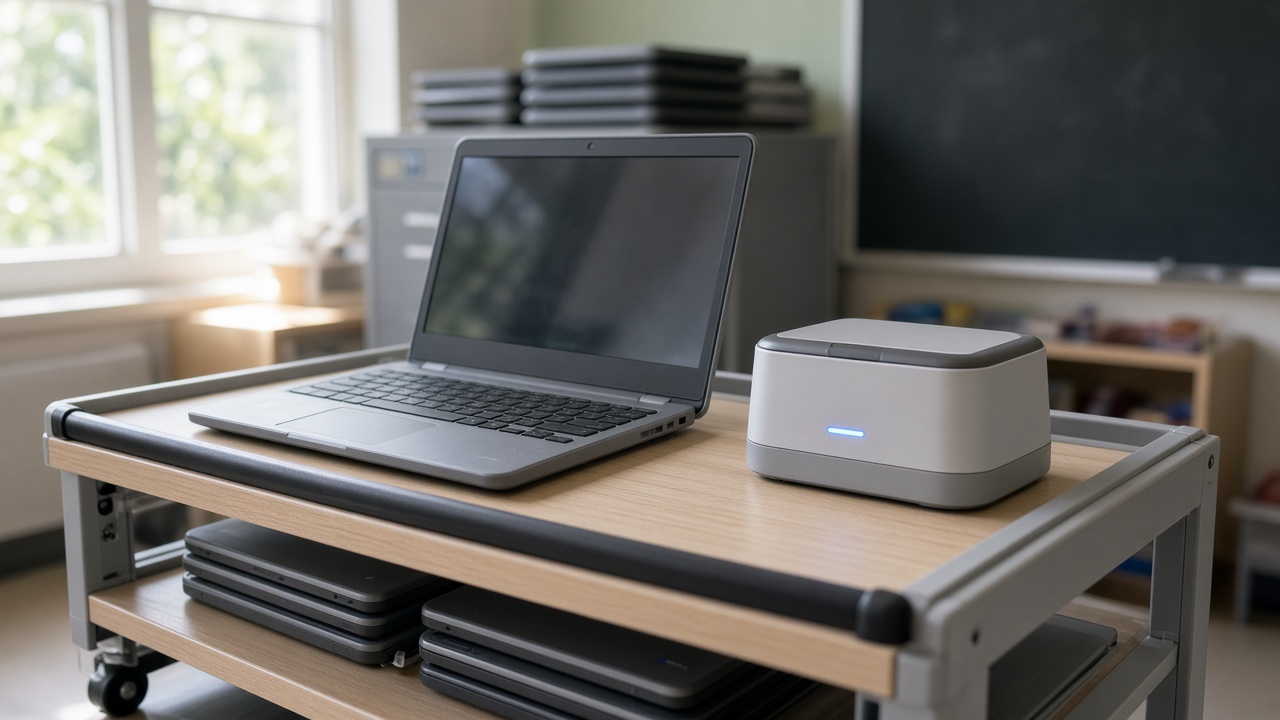
By late September, the Chromebook cart is already the most traveled object in a lot of classrooms. A teacher rolls it out for first period. Students pull devices, type, swipe, and put them back. The next class does the same thing before lunch. Nightly desk cleaning does not reach that rotation.
AI-generated. This article was written with AI from the linked reporting and studies. Use the original sources for the full papers and published data.
We wrote about the school-office pen in August and the flu-clinic clipboard two weeks ago. Education is still Cleanint's first growth priority. The question this week is narrower: when a campus runs 1:1 or cart-based devices, which shared objects the schedule cannot stop sharing, and what belongs next to the cart.
What CDC already puts on the list
CDC's everyday actions for K–12 schools, last reviewed May 12, 2026, list computer keyboards among the surfaces schools should clean and sanitize daily — alongside desks, doorknobs, faucet handles, phones, and toys. The same guidance names shared objects as one of the reasons infections move through a building.
That is not a new discovery from a product company. It is the federal floor for routine school hygiene. A separate CDC toolkit for school administrators goes further on electronics: limit shared computers when possible, or clean and disinfect between use, and discourage sharing devices that are hard to clean.
Most campuses cannot stop sharing. Device budgets and cart schedules make that decision for them. The honest job is sanitation that fits the rotation already on the wall.
What one school outbreak actually found on a keyboard
In February 2007, the District of Columbia investigated a norovirus outbreak in an elementary school. After the first wave of illness, investigators found that one first-grade classroom was independently associated with higher attack rates. That classroom was also the only one where students and staff shared computers.
CDC reported identical norovirus RNA on a shared classroom computer mouse and keyboard. The editorial note called it the first report of norovirus detected on those objects in an outbreak investigation, and it highlighted how hard it is to find and disinfect every environmental source during a school GI outbreak. No food service explained the classroom spike. Water-fountain samples were negative. The shared computer was the environmental clue that fit the epidemiology.
That paper is about norovirus, not influenza. It does not prove a Chromebook caused the outbreak by itself. It does show that shared school computers are not theoretically dirty. In at least one documented campus outbreak, they tested positive for the same pathogen making children sick, and the classroom that shared them stood out.
The classroom surface data we have for respiratory season is smaller and should be read that way. In 2010, University of Arizona researchers sampled six elementary classrooms in the Seattle area. Influenza A RNA showed up on 24% of surfaces overall and on 50% of surfaces by afternoon. The most bacterially loaded objects were water-fountain toggles, pencil-sharpener handles, keyboards, and faucet handles. Children in classrooms that were not wiped daily were more than twice as likely to report illness-related absenteeism. The authors called the work preliminary. It is still the classroom sample later hygiene writing keeps returning to.
Why a wipe schedule stalls on electronics
Keyboards and trackpads are high-touch and awkward. Spray the wrong liquid and you void a warranty. Skip the wipe and the next student inherits whatever the last period left on the keys. Carts move between rooms. Substitutes inherit someone else's device stack. By third period, the "daily clean" on the custodial checklist has already fallen behind the handoffs.
CDC's school language on flu remains careful elsewhere on our site: influenza spreads mainly by droplets when people cough, sneeze, or talk. Surfaces are the secondary route — less often, not never. Norovirus is a different pathogen with a stronger environmental reputation. The shared claim across both is practical: when many hands use the same non-porous controls during the day, those controls belong on the cleaning list, not only the desks around them.
Vaccination, ventilation, staying home when sick, and handwashing are still the first lines. A UV cradle does not replace any of them.
What belongs next to the cart
CleanintUV is an enclosed UV-C cradle for the handhelds that never get washed between classes — phones, badges, remotes, and, in a cart room, the devices staff can cycle between periods without spraying the keyboard. Put the unit where the cart already parks. A teacher or aide parks a device for a cycle, then hands it back into rotation. That is the whole product idea. The unit is $249.95. It is not a wipe substitute for every laptop in a 30-device cart, and it is not a claim that UV light will move a district's absenteeism rate.
The cart-room list is short: the charging station between periods, the media-lab checkout shelf, the library laptop bar, the nurse's tablet, the admin Chromebooks that leave the office for testing days. If the cradle is not where devices already rest, it will not get used.
Cleanhands is the staff half of the same idea. It clips to a belt, lanyard, or cart keyring. One-hand dispense, no cap to drop. Each cartridge is 75% isopropyl alcohol, up to 1,000 sprays, about 2 oz. The double pack is $24.95. Teachers and aides are the people who cannot walk to a sink between the last return and the next checkout.
Cleanpen belongs in a different sentence on the same cart day. A touchscreen stylus or a lab sign-out pen is still a shared barrel. The holder sanitizes between uses and sits where people already grab that tool. The holder with one refill is $22.99. It is not the Chromebook product. It is the signature-and-stylus product that often lives in the same room.
None of this claims a $250 cradle will stop a norovirus season. The DC investigation is not a trial of UV-C. CDC lists keyboards because they are touched often, not because a single device brand owns the problem. The honest product claim is smaller: September is when cart rotation is already dense, shared school computers have shown up in outbreak sampling, federal guidance already names keyboards as daily high-touch surfaces, and sanitation that fits the cart schedule is the kind that survives third period.
Park the cradle where devices already rest. Clip sanitizer on the people running the cart. Refill both. Keep the wipe schedule for the keys you can wipe safely. That is what belongs next to the Chromebook cart this September.
Where to read more
CDC. Everyday Actions for Schools to Prevent and Control the Spread of Infections. Last reviewed May 12, 2026. https://www.cdc.gov/children-and-school-preparedness/infection-prevention/actions.html
CDC. Cleaning, Disinfection, and Hand Hygiene in Schools – a Toolkit for School Administrators. https://stacks.cdc.gov/view/cdc/97530
CDC. Norovirus Outbreak in an Elementary School — District of Columbia, February 2007. MMWR. January 4, 2008 / 56(51);1340-1343. https://www.cdc.gov/mmwr/preview/mmwrhtml/mm5651a2.htm
Bright KR, Boone SA, Gerba CP. Occurrence of bacteria and viruses on elementary classroom surfaces. J Sch Nurs. 2010.